
Fortuna offers structure and security for your practice, saving you time and stress by ensuring that you are up to date with all that you need to be.
It is a perk of your membership with PTUK/PTI, providing a scaffold for our dynamic work.
Steering your practice journey safely.
Fortuna offers structure and security for your practice, saving you time and stress by ensuring that you are up to date with all that you need to be.
It is a perk of your membership with PTUK/PTI, providing a scaffold for our dynamic work.

All records, reports and notes are safely stored in compliance with professional and ethical standards.
Keeping notes for your own development and logging sessions for proof of safe and best practice.
Fortuna can create, file, and merge invoices.
Apply for new grades, renewals or revalidation with a clear list of hours accrued. Store insurance, ICO, DBS and more together for the full picture of your compliance.
Demonstrate your training, experience and competence easily through structured entries.
Built-in templates and logs can produce graphs and progress tracks with SDQ data.
Your data belongs to you. Reports are only ever made from anonymous, averaged datasets of 200 cases or more.
Anonymised and aggregated data is routinely shared with members and the professional field at large.
Fortuna is a secure, digital record-keeping and note-making database, for member practitioners.
Although processed by PTUK, the data belongs to the members.
As well as their own record keeping and note management, members can make use of PTUK’s processing of the data. Requests for information are made daily. These requests are for information relevant to their request and framed in a useful way to meet their particular brief. This can then be used alongside larger sample sizes.
These requests range in depth and detail and can add weight and scope to the individual member’s existing argument or proposition. Members do not have to ask to gain from this reporting resource, as regular posts on GTK and social media are well received, and online member resources host archived reports.
PTUK is motivated to communicate outcomes of the Integrative Holistic Model of Play Therapy widely. PTUK strive for effective, early, and expert help for child mental health. Dissemination of information is achieved through headline social media items, newsletter articles, academic papers and on an individual basis by member request.
We are dedicated to presenting data differently for different uses, so that every member can have what they need to support their work.
Data is often what gains us a seat at the table with other therapeutic interventions offered to children, helps us to work closely with other organisations, and puts Play Therapy on the mental health map.
Every report is made from anonymous, averaged datasets, never individual session notes.
Only anonymous, averaged datasets of 200+ cases are used.
Gender, age and ethnicity, supporting inclusion and diversity in provision.
Referral conditions show which needs are most common and how they change over time.
Before-and-after SDQ results, tracked across all five sub-categories: our strongest argument at a national level.
Averaged use of Toolkit media by referral, gender and session type. No session notes. Not linked to SDQ results.
How well Hopes & Expectations are met: qualitative data alongside the numbers.
About half of every Fortuna field is currently left empty or marked ‘unknown’. Fortuna doesn’t correct typos or match up likely data. Unless entered correctly, records will not show.
With more accurate data input, we could have twice as much to go on.
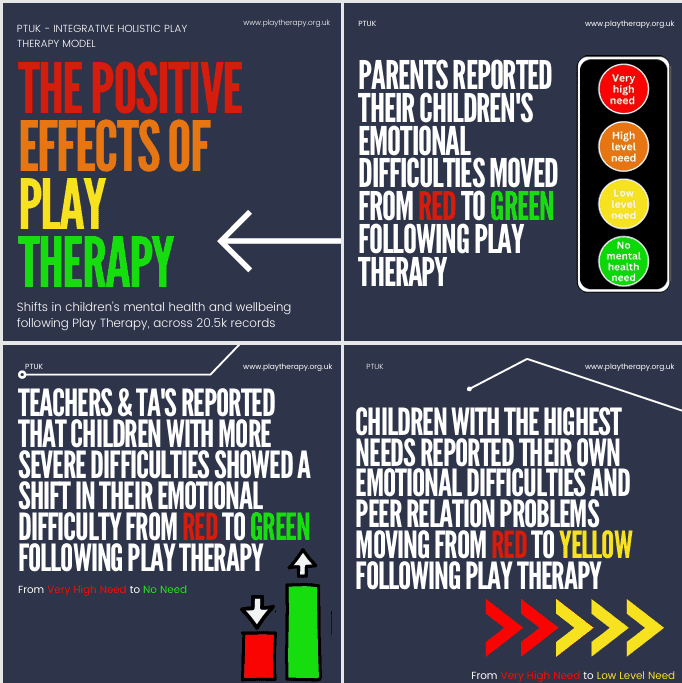
February 2023
Parents, teachers and children all reported shifts in emotional wellbeing following Play Therapy, from very high need towards no need.
20.5k records analysed
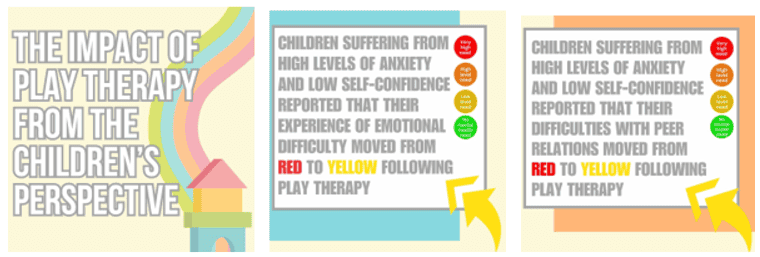
April 2024
Children with high levels of anxiety and low self-confidence reported their emotional difficulties and peer relations moving from red to yellow.
Very high need → low need children’s own reports
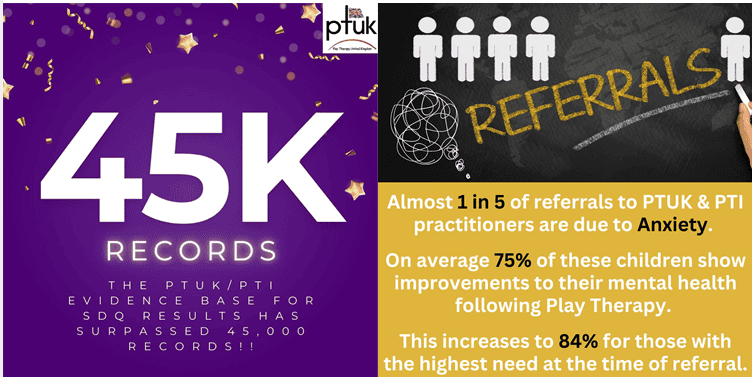
March 2025
The SDQ evidence base passed 45,000 records. Almost 1 in 5 referrals are due to anxiety. On average, 75% of these children improve.
84% improve with the highest need
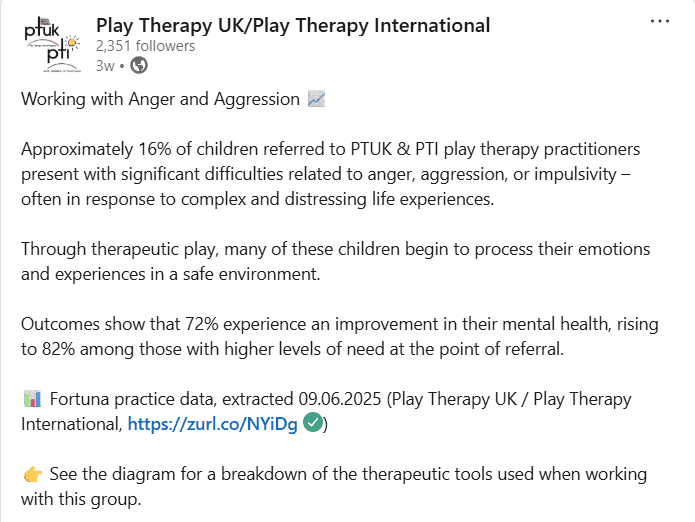
June 2025
Around 16% of children referred present with anger, aggression or impulsivity. 72% experience an improvement in their mental health.
82% improve with higher need

Included with your PTUK / PTI membership.



© 2026 Play Therapy UK.